
The floor of a cow shed decides how comfortable, safe and clean the whole shed is. Bare concrete gets slippery, hard and hard to keep dry. A rubber mat for cow shed floors is the most common fix: a heavy, waterproof rubber layer that gives grip, cushioning and an easy-to-wash surface. This guide covers cow shed flooring from start to finish: the options, where to lay rubber cattle mats, how to prepare the floor, how many mats you need, cost per sq ft, installation, cleaning and where to buy in Patna and across Bihar. If you want the basics of the mat itself, read our complete cow mat guide first.
In short
Prepare a clean, level floor with a gentle slope to the drain. Cover the standing and resting stalls first, then the feeding alley and walkways. Count mats by dividing total sq ft by the mat area, and compare price per sq ft. See our 6.5 x 4 ft rubber mat.
In this guide
Why cow shed flooring matters
Cows spend most of the day standing, walking and lying down on the same floor. A poor floor shows up quickly:
- Slips and falls. Wet concrete with urine, dung and water is slippery, especially for calves and heavy cows.
- Hard standing surface. Long hours on bare concrete are tiring for legs, knees and hocks.
- Dirty, damp stalls. A floor that stays wet makes the shed smell and is harder to keep hygienic.
- Floor wear. Constant scraping and washing damage plain concrete over time.
- More bedding and more labour. A hard, wet floor needs more bedding and more cleaning effort every day.
Good flooring does not fix everything, but it removes several daily problems at once.
Cow shed flooring options compared
| Flooring | What it gives | Watch out for |
|---|---|---|
| Bare concrete | Strong and already there | Slippery when wet, hard to stand on, wears down |
| Grooved or rough concrete | More grip than a smooth floor | Still hard, can be rough on hooves |
| Sand or straw bedding | Soft resting surface | Needs topping up and removing, more daily work |
| Rubber mats | Grip, cushioning, waterproof, easy to rinse | Needs a level floor and daily cleaning; one-time cost |
Many farms combine them: rubber mats on the standing and resting area, with a little bedding on top where needed. A mat does not replace good drainage or regular cleaning, it works with them.
Where to use a rubber mat for cow shed floors
You do not have to cover everything at once. Start with the places where animals spend the most time and where slips happen most.
Standing and resting stalls
This is the most important area. A cow standing mat or cow resting mat under every stall gives the animal a firm grip and a softer surface to lie on. The Dairy Suvidha mat is 6.5 ft x 4 ft, a common fit for one adult cow stall.
Feeding alley and manger area
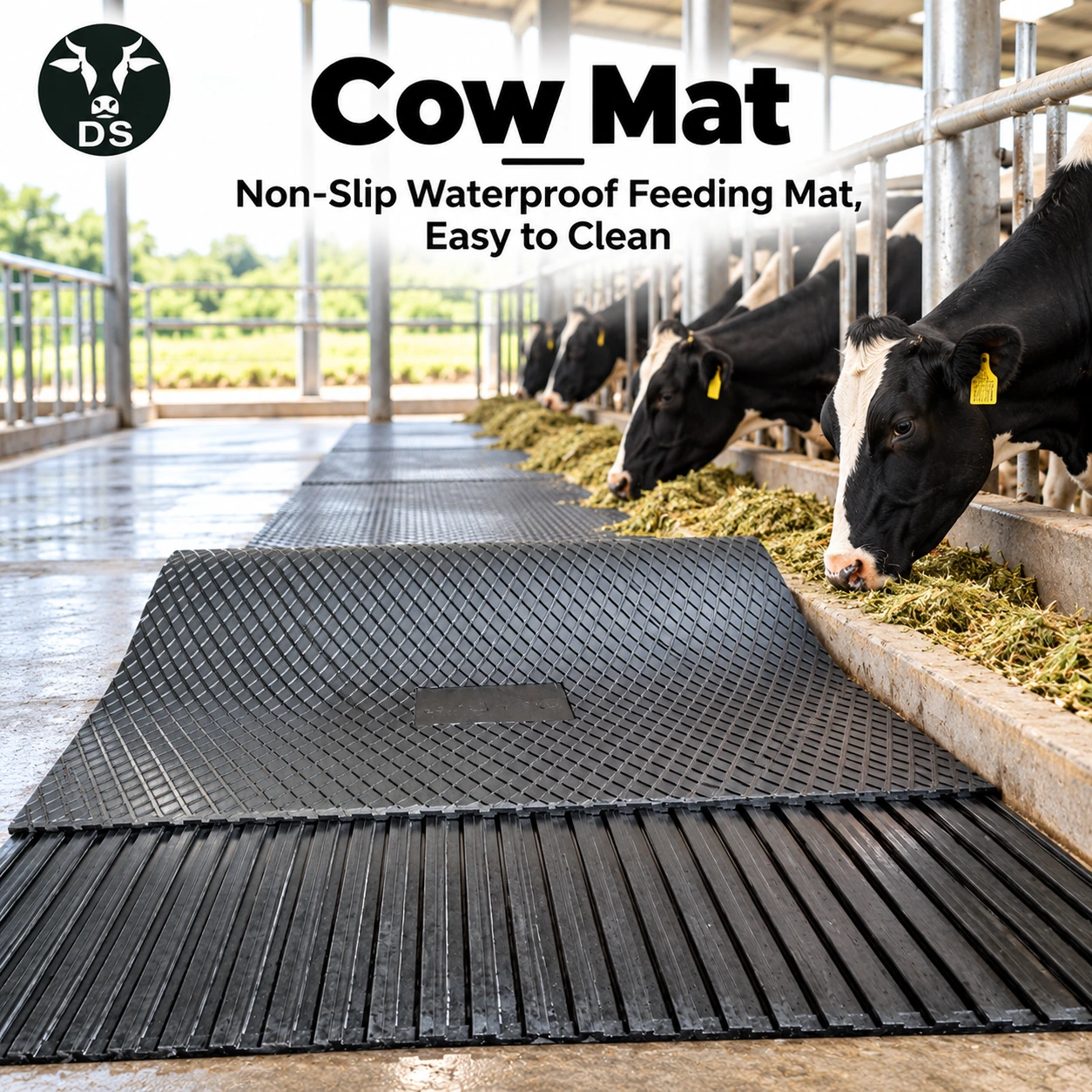
Cows stand in the same spot to eat, and feed and water spill on the floor. Mats along the alley give better grip and are easy to wash.
Walkways and passages
A cow walking mat on the passages to the milking area and the exit lowers the risk of slips where animals move in groups.
Milking area entry
The approach to the milking point is often wet. A mat here gives steadier footing for the cow and for the person milking.
Calf pens, maternity and sick pens
Calves and weak animals need a softer, drier surface. A calf and cow rubber mat in these pens keeps them off bare concrete.
Gaushala
A mat for gaushala use faces heavy daily washing and many animals. Choose full rubber and plan extra mats for walkways.
Rubber cattle mats for a dairy farm and for a home cattle shed
The same idea works at every scale, but the priorities change. On a commercial dairy farm, dairy stall mats and cow stall mats are laid across many stalls, so durability, uniform size and a supplier who can deliver more of the same mat later all matter. A rubber mat for a dairy farm also has to stand up to daily hosing and heavy traffic through the alleys.
In a small home cattle shed with a few animals, you may only need mats for the standing area. Start with one mat per animal and add the feeding area later. Dairy rubber flooring does not have to be done in one go; many owners cover the stalls first and extend it over time.
Whatever the size, plan the layout on paper first, so you buy the right number of mats and keep walkways and drains clear.
Prepare the floor before you lay mats
A rubber mat for cow shed floors is only as good as the floor under it. Spend an hour on preparation and it will pay back.
- Clean it. Remove dung, stones, old bedding and loose material.
- Check the level. Fill hollows and cracks, because water collects in them and sits under the mat.
- Check the slope. The floor should drain towards the drain line, so water does not pool in the stalls.
- Let it dry. Lay mats on a dry floor, not on wet concrete.
- Keep drains clear. Do not cover the drain channel with a mat.
Plan size and quantity
Before you buy a rubber mat for cow shed use, measure each area in feet. For a standing area, a stall for one adult cow is commonly about 6 to 6.5 ft long and 4 ft wide, but animals differ, so measure your own shed. The method:
- Measure length and width of each area (stalls, alley, walkway) in feet.
- Multiply length by width to get the area of each part in sq ft.
- Add the areas together.
- Divide the total by the area of one mat. A 6.5 ft x 4 ft mat is 26 sq ft.
- Round up, and add one or two spare mats.
| Example area | Size | Area (sq ft) | Mats (26 sq ft each) |
|---|---|---|---|
| 10 standing stalls | 10 stalls of 6.5 x 4 ft | 260 | 10 |
| Feeding alley | 40 ft x 4 ft | 160 | 7 (6.2 rounded up) |
| Walkway | 30 ft x 4 ft | 120 | 5 (4.6 rounded up) |
| Total for this example | 540 | 22 plus 1 or 2 spare |
This is only an example to show how to size a rubber mat for cow shed floors. Your layout will be different, so use your own measurements. Your branch can help you check the count.
Rubber mat for cow shed: cost and price per sq ft
The simplest way to compare offers is price per sq ft, not price per mat. Divide the price of one mat by its area, then multiply by the sq ft you need.
| Step | Example (numbers for illustration only) |
|---|---|
| Price of one 6.5 x 4 ft mat | Rs 3,800 (check the live price on the product page) |
| Area of one mat | 26 sq ft |
| Price per sq ft | 3,800 divided by 26 = about Rs 146 |
| Cost for 22 mats | 22 x 3,800 = Rs 83,600, plus delivery |
The live price is on the rubber mat product page, and freight for your pincode is shown before you pay. When you compare, look at thickness, weight, rubber quality and warranty too. A cheaper, thinner and lighter mat can cost more in the long run.
Thickness, weight and grip: what to ask the seller
Two mats can look the same and still be very different. These are the questions that matter when you compare cattle floor mats or any rubber mat for cattle:
- What is the thickness in millimetres? Thicker rubber cushions better but weighs and costs more.
- What does one mat weigh? Weight is a quick way to judge how much rubber is in it. Our 6.5 x 4 ft mat weighs about 40 kg.
- Is it full rubber? Avoid thin or mixed-material sheets for heavy daily use.
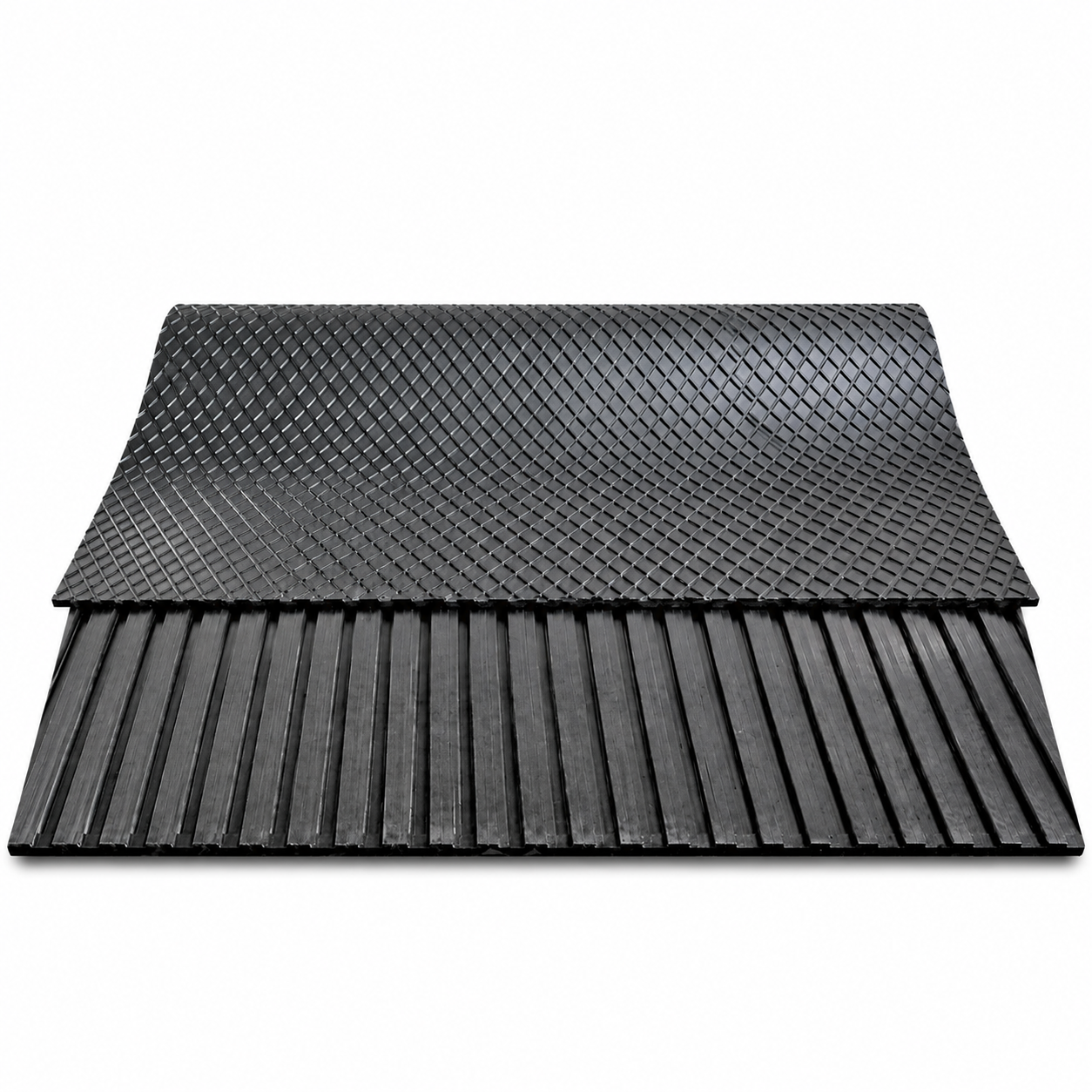
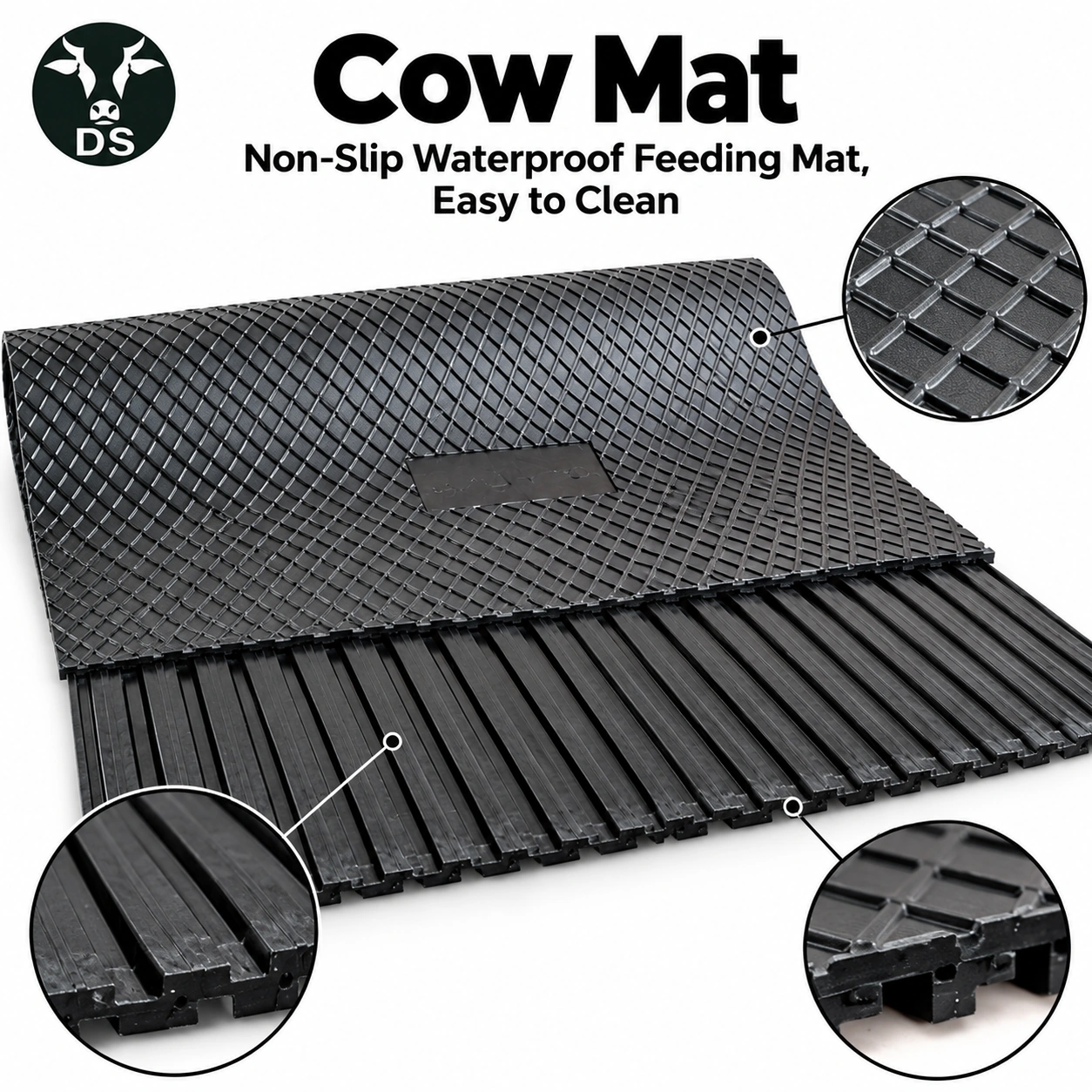
- What is the surface pattern? A diamond-top surface grips better than a smooth one.
- What is the underside like? A ribbed or grooved back helps the mat sit firm and lets water drain.
- What warranty and invoice do you give? Ask for both in writing.
Ask the same questions of every seller and write the answers side by side. It is the easiest way to tell a good mat from a cheap one.
How to install a rubber mat for cow shed floors, step by step
- Clean and dry the prepared floor.
- Unroll or place the first mat in a corner with the patterned (diamond-top) side up.
- Lay the next mats edge to edge with a small, even gap, so the rubber can settle and drain.
- Cut a mat to size at the walls or the drain with a sharp knife if needed.
- Keep the drain channel open and leave the mats off the drain line.
- Walk on the mats yourself first to check for lifting edges, then bring the animals in.
Read the warranty and installation page to see what the warranty covers.
Common mistakes with a rubber mat for cow shed floors
- Laying mats on a wet, cracked or uneven floor.
- Covering the drain, so water pools under the mat.
- Buying only on the lowest price without checking thickness and weight.
- Using a thin or mixed sheet in a heavy-use stall.
- Skipping daily cleaning, which makes any mat slippery.
- Leaving large gaps or loose edges that animals can catch a hoof on.
- Using harsh chemicals that can damage the rubber.
Cleaning and maintenance schedule
| How often | What to do |
|---|---|
| Daily | Remove dung and leftover feed, rinse with clean water, let the mats dry |
| Weekly | Scrub lightly, check the edges for lifting and the drains for blockage |
| Monthly | Lift one or two mats to check the floor and underside, fix hollows, refit loose edges |
How to choose a rubber mat for cow shed use
- Full rubber, not a thin or mixed sheet.
- Grip pattern such as diamond-top for wet floors.
- Ribbed or grooved underside so the mat stays in place.
- Size and weight checked for the stall.
- Thickness in millimetres, compared across sellers.
- Warranty and GST invoice from a seller with local support.
For a deeper checklist on size, thickness and price, see our cow mat guide.
Buy a rubber mat for cow shed in Patna and Bihar
Dairy Suvidha (Manish Enterprises) is in Patna at Road No. 5, Doctor Colony, Kharauniya, Chhoti Pahari, behind Big Apollo Spectra Hospital. Open the Patna branch page for the address and hours. Our full rubber mat for cow shed use is 6.5 ft x 4 ft, weigh about 40 kg each, have a diamond-top surface and a ribbed underside, and come with a 1 year warranty and a GST invoice. See the details and the live price on the product page.
Orders are billed and delivered by the branch that serves your pincode. Pay on delivery is available on this mat. See Shipping and Delivery, the refund and cancellation policy and the FAQ page.
गाय के शेड के लिए रबर मैट
गाय के शेड की फर्श पर रबर मैट बिछाने से फिसलन कम होती है, पशु को खड़े होने और बैठने के लिए नरम जगह मिलती है और सफाई आसान होती है। शेड के लिए मैट चुनते समय पूरा रबर, ग्रिप वाली सतह, नीचे ग्रूव, साइज़, वज़न और वारंटी देखें। पहले गाय के खड़े होने और बैठने की जगह पर मैट लगाएँ, फिर फीडिंग एरिया और रास्तों पर।
बिहार, झारखंड और उत्तर प्रदेश में डिलीवरी उपलब्ध है। रेट और ऑर्डर के लिए प्रोडक्ट पेज देखें या अपनी नज़दीकी ब्रांच से WhatsApp या कॉल पर बात करें।
Complete your cow shed
A good floor is one part of a good shed. Pair it with these products. For wider guidance on dairy farming and animal care in India, you can also read the resources of the National Dairy Development Board and the Department of Animal Husbandry and Dairying.
- Stainless steel phawda and plastic phawda for cleaning the floor
- Loha gobar trolley for moving dung
- Cow feeding trough (nad) and water drinking bowl
- Anti kick bar for cow for safer milking
- Cow rubber brush and cow bath glove
- Cow blanket for winter care
Browse the full Animal Care and Feeding range.
Rubber mat for cow shed: FAQs
Which is the best rubber mat for cow shed floors?
The best choice is a full rubber mat with a grip pattern such as diamond-top, a ribbed or grooved underside, enough thickness and weight for your animals, and a written warranty. You can see one such option on the Dairy Suvidha cow mat page.
Can I lay rubber mats directly on a concrete floor?
Yes. Rubber mats are made to be laid on a clean, dry, level concrete floor. Fix cracks and hollows first, and keep the drain line clear so water does not collect under the mat.
Do I need to cover the whole cow shed floor with rubber mats?
No. Most farms cover the standing and resting stalls first, then the feeding alley and the walkways animals use most. Start where animals spend the most time and slip the most.
How many rubber mats do I need for my cow shed?
Measure each area in feet, multiply length by width to get sq ft, add the areas together and divide by the area of one mat. A 6.5 ft x 4 ft mat covers 26 sq ft. Round up and add a spare.
How do I calculate the cost of rubber flooring for a cow shed?
Divide the price of one mat by its area to get the price per sq ft, then multiply by the total sq ft you need. Add delivery to your pincode, and compare mats on thickness, weight and warranty as well as price.
Is a rubber mat better than sand or straw bedding?
They do different jobs. Sand and straw are bedding that you top up and remove. A rubber mat is a fixed, washable surface that gives grip and cushioning. Many farms use a mat and a little bedding on top.
Are rubber cattle mats slippery when wet?
A patterned surface grips better than a smooth sheet, but dung, urine and leftover feed can make any floor slippery. Rinse the mats daily and let them dry.
How often should I clean the mats?
Remove dung every day and rinse the mats with clean water. Scrub lightly once a week and check the edges and drains for blockage.
Can I use the same mat for calves and buffaloes?
Rubber mats are used for cows, calves and buffaloes. Heavier animals need thicker, heavier mats, so confirm size and thickness with your branch before you order.
Where can I buy rubber mats for a cow shed in Patna and Bihar?
Dairy Suvidha (Manish Enterprises) is in Patna at Road No. 5, Doctor Colony, Kharauniya, Chhoti Pahari. See the Patna branch page, or order online. Delivery after dispatch is 3 to 5 working days in Bihar and 4 to 7 working days in Uttar Pradesh and Jharkhand. See Shipping and Delivery.
Get the right rubber mat for your cow shed
Measure your shed, use the count method above, and compare price per sq ft for every rubber mat for cow shed use you consider. Check the details of our rubber mat, or talk to the Patna branch for help with size, quantity and delivery to your pincode.